Last updated June 28, 2026
Seasonal Gate Repair Care for Las Vegas: Year-Round Homeowner’s Guide
Most homeowners think of gate maintenance the same way they think of changing a smoke detector battery — something to do once a year, maybe in the fall. In Las Vegas, that approach leaves your gate completely unprepared for the conditions that actually destroy them: 115°F summer heat that warps aluminum tracks and burns out motor capacitors, followed by a monsoon window that drives humidity into every control box seal summer cracked open. The gate systems we see fail most often in Las Vegas didn’t break overnight — they were weakened incrementally across multiple seasons while the owner assumed everything was fine. This guide will show you exactly when to act and what to check, structured around the three real Las Vegas seasons your gate actually experiences.
Quick Answer
Gate maintenance in Las Vegas should follow three seasonal windows, not a standard four-season calendar: a pre-summer prep phase in April–May, a monsoon-damage check in July–September, and a mild-season repair window from October through March. Skipping the April prep is the single most common reason gate motors fail mid-summer in Las Vegas — heat-stressed components that a 20-minute inspection would have caught become full replacements in July when temperatures peak. Structure your care around those three windows and your gate will outlast neighbors’ systems by years.
Table of Contents
- Why Las Vegas Has Three Gate Seasons, Not Four
- Pre-Summer Prep (April–May): Stop Failures Before They Start
- Monsoon Window (July–September): Water, Rust, and Debris Damage
- Post-Monsoon Assessment: What to Inspect Before Fall
- Mild Season (October–March): The Ideal Window for Real Work
- Thermal Expansion and Gate Gap Tolerances in Las Vegas
- Common Mistakes to Avoid
- When to Call a Professional
- Frequently Asked Questions
- The Bottom Line
Why Las Vegas Has Three Gate Seasons, Not Four
Standard home-maintenance content is written for climates with four roughly equal seasons. Las Vegas doesn’t have that. What Las Vegas actually has is a brutal summer stress period stretching from June through early October, a brief but destructive monsoon window embedded inside that summer, and a mild stretch from October through May where temperatures are genuinely forgiving and most physical work can be done properly.
That means the maintenance windows your gate actually needs look like this:
- April–May: Pre-summer preparation — getting every component ready before the heat arrives
- July–September: Monsoon monitoring — catching water intrusion and corrosion as it starts
- October–November: Post-monsoon damage assessment before the mild season begins
- November–March: Structural repairs, repainting, welding, and anything requiring curing time
In our experience serving Las Vegas homeowners and HOA managers, the residents who follow this three-window structure rarely face emergency repair calls. The ones who skip the April prep phase are the ones calling in August when the motor won’t open a gate on a 112°F afternoon.
The neighborhoods where we see this pattern most clearly are Summerlin, the southwest corridor near Rainbow and Warm Springs, and the master-planned communities in Henderson that push up against the valley’s heat-trap geography. Gate systems in those areas are under above-average thermal stress simply due to western sun exposure on dark powder-coated metal.
Pre-Summer Prep (April–May): Stop Failures Before They Start
April and early May are the most valuable weeks in your gate’s annual calendar. Temperatures are still mild enough to work comfortably, components are at their baseline state before heat stress begins, and any lubrication or adjustment you make now will be in place when the system needs it most. By June, it’s already too late to be proactive — you’re reactive from that point forward.
Here’s the pre-summer inspection sequence we recommend Las Vegas homeowners work through each April:
- Check the motor’s capacitor and run voltage. Capacitors degrade faster in high-heat climates. A motor that cycles fine at 75°F in April can refuse to start at 110°F in July because the capacitor can no longer deliver the startup amperage it needs. If your LiftMaster, FAAC, or BFT operator is more than 3 years old and hasn’t had a capacitor check, April is the time.
- Inspect all wiring harnesses and junction points for cracked insulation. Summer UV plus heat causes insulation brittleness faster in Las Vegas than in coastal markets. Look for any wiring exposed to direct sun on south- or west-facing gate posts.
- Test the gate’s auto-reverse force settings. Heat expands metal tracks slightly, which increases the gate’s effective travel resistance. A force setting calibrated in February may cause the motor to strain in July. Viking, Linear, and Ghost Controls operators all have force adjustment procedures in their manuals — do this check before summer begins.
- Grease the hinges, wheels, and rack gear. Use a high-temperature grease — standard white lithium burns off quickly at Las Vegas summer temperatures. A dry rack gear in July doesn’t just create noise; it accelerates wear on the motor’s drive pinion.
- Test all photo-eye sensors for alignment and lens clarity. Sensors collect dust and desert grit fast here. A sensor running at 80% efficiency in May may drop below the detection threshold when summer heat creates ground shimmer, causing ghost obstruction faults.
- Inspect the control box seal. The gasket around your control board housing is your primary defense against monsoon intrusion. If it’s cracked, brittle, or missing sections, replace it before July — not after water has already reached the board.
This six-step check takes most homeowners about 45 minutes and can prevent hundreds of dollars in mid-summer emergency repair costs.
Monsoon Window (July–September): Water, Rust, and Debris Damage
Las Vegas’s monsoon season runs roughly July through mid-September. It doesn’t bring the sustained rainfall of the Gulf Coast, but it brings something arguably more damaging for gate systems: rapid-onset storms that dump large amounts of water in a short window, followed immediately by a return to high heat. That cycle — sudden wet, fast dry, high heat — is ideal for initiating rust at weld points and driving moisture into control boxes that sit sealed and hot for days afterward.
During the monsoon window, your job isn’t to do major repairs. It’s to inspect and document so that any emerging damage gets caught before it compounds. Here’s what to check after each significant storm:
- Control box interior: Open the operator housing and look for any moisture beading on the circuit board or wiring. Even a small amount of condensation inside a DoorKing, Elite, or Mighty Mule operator can initiate corrosion on solder points. Wipe with a dry cloth and identify the entry point before resealing.
- Weld points and frame joints: Water pools at the base of gate posts and at the bottom rail. This is where rust initiates fastest in Las Vegas because the metal is already fatigued from heat expansion. Look for rust bubbling or paint lifting at any welded joint — this is the first visible sign of structural corrosion.
- Sensor lenses and alignment: Monsoon winds carry debris that can physically chip sensor lenses or knock them out of alignment. A misaligned photo-eye after a storm is among the most common service calls we see in Las Vegas between July and September.
- Track and rack drainage: Flat or low-slope driveways in master-planned communities sometimes allow water to pool along the gate track. Sand and grit suspended in that water then dries inside the track, accelerating wear on wheel bearings. Flush the track with clean water after any pooling event.
- Access control keypad and intercom: Water intrusion into keypad units is common during monsoon storms, particularly on older BFT or DoorKing units whose face seals have aged. If the keypad is intermittent after a storm, water intrusion is the first thing to rule out.
What you should not do during the monsoon window is defer a structural concern to “later in the year.” Rust that starts at a weld joint in August and sits untreated until December has had four months to penetrate the base metal. What was a surface-level repair in October becomes a full section replacement by spring.
Post-Monsoon Assessment: What to Inspect Before Fall
The window from late September through October is the most underutilized maintenance period for Las Vegas gate owners. The heat is breaking, the monsoon is over, and the mild season hasn’t fully settled in yet — but this is exactly the right time to do a full-system damage assessment and decide what needs professional attention before winter.
Think of this as your annual “damage report” before committing any repair budget. Here’s what a thorough post-monsoon inspection covers:
- Motor thermal performance review. If the motor struggled, stalled, or tripped thermal overload during any point in July–September, document it. A motor that thermally trips even once under normal load is telling you the capacitor or internal winding is degraded. Plan the replacement in October when parts availability is better and you’re not racing the heat.
- Full rust and corrosion audit. Walk the entire gate frame — top rail, bottom rail, vertical pickets, hinge plates, post base, and wheel axles. Note every rust spot, no matter how minor. Anything deeper than surface oxidation needs prep and treatment before the mild season is over.
- Hardware torque check. Expansion and contraction cycles over the summer loosen fasteners faster in Las Vegas than in mild-climate markets. Check all hinge bolts, track mounting hardware, and operator bracket fasteners. A gate that has developed a 1/4-inch sag is always a fastener issue until proven otherwise.
- Access control credential audit. If your property had any unauthorized access attempts or credential failures during the summer, October is the right time to reprogram access codes, review gate log data on capable systems, and update keypad codes that may have been shared with seasonal workers or contractors.
- Battery backup test. If your operator has a battery backup module — standard on most current LiftMaster and Viking operators — test it under load. Batteries degrade faster in high-heat environments. A battery that passed last October may have lost significant capacity after one Las Vegas summer.
Mild Season (October–March): The Ideal Window for Real Work
If you’ve done your pre-summer prep and your post-monsoon assessment, the mild season is where you act on everything that needs hands-on repair. Las Vegas from November through February offers the ideal physical conditions for structural gate work: temperatures between 45°F and 65°F, low humidity, minimal UV intensity, and long enough dry windows for paint and coating to cure properly.
This is the window for:
- Welding repairs and fabrication. Weld quality is significantly better in mild temperatures. Heat-affected zones behave more predictably, and there’s no risk of rapid weld cooling from ambient cold or overheating from ambient summer heat. Our in-house welding capability means structural repairs can be scheduled and completed without coordinating with a separate metal shop — which is especially relevant for Las Vegas HOA managers who need single-point accountability.
- Full repainting or powder coat touch-up. Paint and rust-inhibiting coatings need adequate cure time at moderate temperatures. A coating applied in July in Las Vegas will blister. A coating applied in November will cure properly and bond to the substrate the way the manufacturer intended.
- Motor and opener replacement. If the post-monsoon audit flagged a degraded motor, replace it before spring. Operator availability is better in winter months, and scheduling a non-emergency replacement is always cheaper than an emergency call in June.
- Track realignment and leveling. Any settling of the driveway surface — common in new construction areas of North Las Vegas and the southwest valley — affects gate travel alignment over time. Winter is the right time to re-survey the track grade and correct it while the asphalt is in its most stable thermal state.
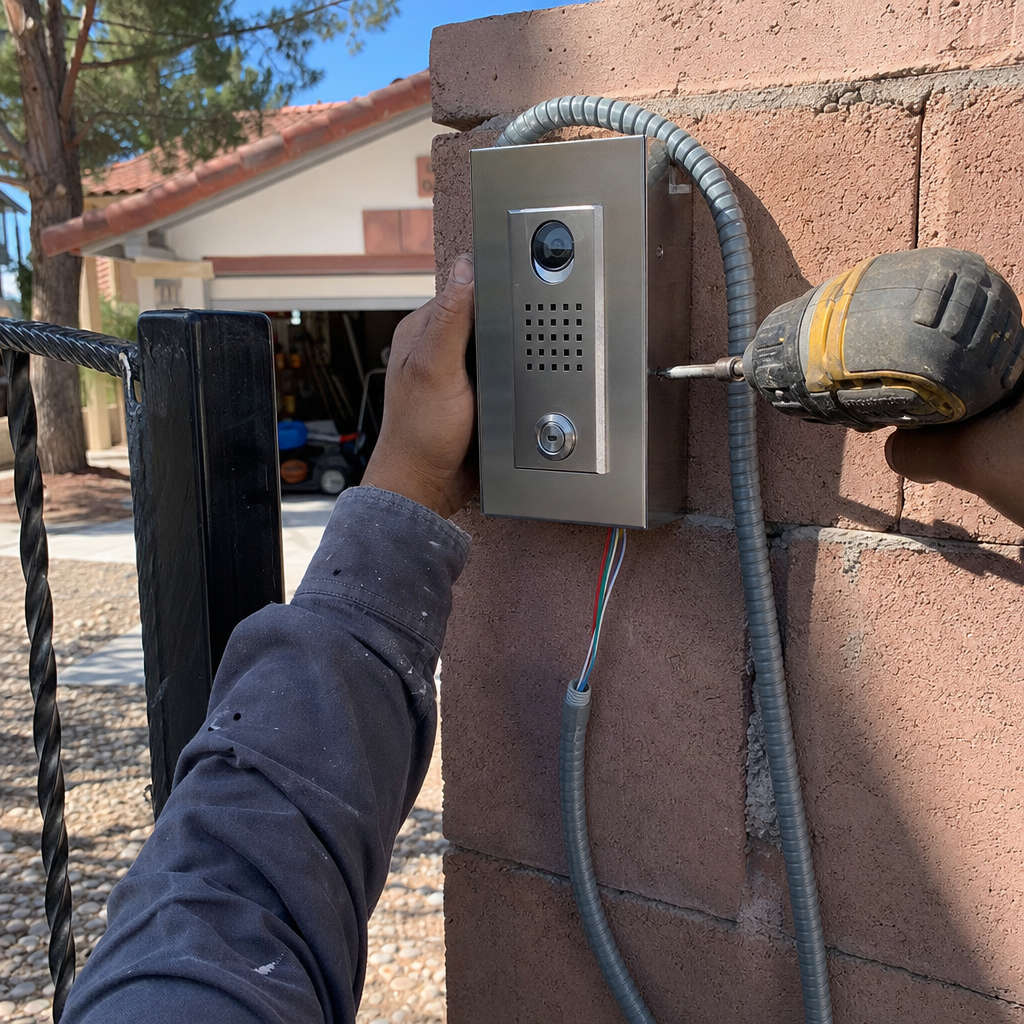
- Access control upgrades. If you’ve been considering a keypad upgrade, video intercom, or cloud-based access control, the mild season gives us time to run conduit, make cuts in gate posts, and complete the work without racing heat-related deadlines.
Thermal Expansion and Gate Gap Tolerances in Las Vegas
This is the section most homeowners — and a lot of generalist technicians — skip entirely. It matters more in Las Vegas than almost anywhere else in the country.
A standard aluminum or steel swing gate or slide gate expands measurably between its winter minimum temperature and its summer maximum. In Las Vegas, that swing is roughly 70°F on a typical year — from around 35°F on a January night to over 105°F on a July afternoon. A 16-foot steel slide gate can expand by approximately 1/8 to 3/16 inch across that range. That doesn’t sound like much until the gate was set with a 1/4-inch clearance to the stop post in February.
What this means practically:
- Gates set too tight in winter will bind in summer. A gate with insufficient clearance to its stop post will begin to strain the motor every summer as the frame expands into the stop. The motor fights this resistance every cycle, which accelerates internal wear. We regularly see this in gates installed by generalist handyman companies who didn’t account for Las Vegas’s thermal range.
- Gates adjusted in summer may have excess gap in winter. If a technician sets your swing gate clearance during a July service call, that gap will be visibly larger in January. For residential security gates, a 3/8-inch gap that opens up in winter may not be a safety issue, but it should be noted and documented.
- The correct approach is to calibrate at mid-range temperature. The ideal setup temperature for a Las Vegas gate is in the 65–75°F range — October or April. Setting clearances at that temperature gives you roughly equal thermal movement in both directions. If your gate was installed or adjusted at temperature extremes, it may be worth having the clearances re-checked during the mild season.
- Track-mounted slide gates are particularly sensitive. The track itself expands, and if expansion joints weren’t built into a long driveway track, the track can bow slightly and cause the gate carriage wheels to bind or jump. This is a structural issue, not an operator issue — and it’s one we see in properties in Summerlin and the Lakes area where long driveways with continuous concrete bases are common.
Understanding thermal expansion is part of why the Elite Gate Repair Expert Vegas home approach to installation includes explicit documentation of the installation temperature and designed clearances — information that’s useful every time we return for a service call.
Common Mistakes to Avoid
- Using standard white lithium grease on gate components in summer. White lithium grease has a relatively low melting point and will liquify and run off gate rack gears and hinges when surface temperatures hit 120°F+ in direct Las Vegas sun. Use a high-temperature synthetic grease rated for at least 300°F for summer applications — the type used on trailer hitches and heavy equipment is appropriate.
- Deferring a water intrusion finding until “winter.” If you open your control box in August and see moisture, treating this as a “schedule for later” issue is the most expensive mistake a Las Vegas homeowner can make. Standing moisture on a circuit board initiates corrosion within days in heat. A $40 gasket repair becomes a $400 control board replacement if ignored across August and September.
- Setting gate travel limits only in extreme temperatures. A technician who calibrates your motor’s travel limits in July (metal fully expanded) or January (metal fully contracted) is setting you up for limit switch problems at the opposite extreme. Always note the ambient temperature when limits are set, and plan to verify at mid-season.
- Ignoring small rust spots at weld joints. Welded joints are where dissimilar stress points meet. In Las Vegas’s heat-and-monsoon cycle, a rust bubble at a weld joint that’s ignored through two seasons can penetrate the base metal enough to require section replacement rather than surface treatment. Catch it early — in the post-monsoon window — and it’s usually a wire brush, rust converter, and a touch-up coat.
- Assuming a gate motor brand is interchangeable. Replacing a FAAC operator with a generic or off-brand unit to save money often creates compatibility problems with existing access control wiring and mounting hardware. Staying within a supported brand family — and working with a technician certified on that brand — avoids expensive rework. This matters especially for HOAs in Las Vegas that have existing DoorKing or BFT access control infrastructure.
- Skipping the battery backup test after summer. Battery backup units in operators like LiftMaster and Viking are designed to get your gate through a power outage — but a battery degraded by one Las Vegas summer may only last 3–5 cycles instead of the 20+ it’s rated for. Test it every October under real load, not just the indicator light check.
- Letting desert debris accumulate in the gate track. Las Vegas’s dust storms and monsoon winds push sand, gravel, and tumbleweeds directly into slide gate tracks. A track full of grit acts as an abrasive on wheel bearings and increases motor load incrementally. Clear the track after every significant wind or rain event — it takes two minutes and extends the life of both the wheels and the operator.
When to Call a Professional
Some gate maintenance tasks are genuinely homeowner-friendly: clearing track debris, checking sensor alignment, lubricating hinges, and opening a control box to look for visible moisture. But several scenarios call for a trained gate specialist rather than a DIY approach or a generalist handyman.
Call a professional when:
- The motor strains, stalls, or trips thermal overload — this indicates a mechanical or electrical issue that worsens with each cycle
- You see rust penetrating a weld joint below the surface layer — structural integrity assessments require hands-on inspection
- The gate binds, stops mid-travel, or reverses without obstruction after temperature changes
- Any wiring shows cracked or brittle insulation, or there’s evidence of water inside the control box
- You need to recalibrate force limits or travel settings after a motor replacement
- Access control credentials need reprogramming on commercial-grade systems like DoorKing or BFT
For Las Vegas homeowners and property managers, Gate Repair in Winchester and surrounding areas is covered by Elite Gate Repair Expert Vegas — Albert Foster personally handles technical work on every job, on all nine supported brands. Call (725) 210-0591 for a free estimate. No call center, no subcontracted crew.
Frequently Asked Questions
How often should I service my gate in Las Vegas?
A Las Vegas gate needs a minimum of two structured inspections per year: one in April before summer heat arrives, and one in October after the monsoon season ends. The April check is the more critical of the two because it’s the last opportunity to address heat-vulnerable components before peak stress season. Homeowners with high-cycle gates — properties with multiple daily trips — benefit from adding a brief monsoon-window check in August as well.
What’s the most common gate failure in Las Vegas during summer?
Motor capacitor failure is the most common single-point summer failure we see in Las Vegas. Capacitors degrade faster at sustained high temperatures, and a unit that cycles fine at spring temperatures may fail to start the motor on a 110°F July afternoon when the capacitor can no longer deliver the startup surge the motor needs. This failure is almost always preventable with an April capacitor check. Call (725) 210-0591 to have yours tested before summer — the inspection is free.
Does Las Vegas’s monsoon season actually damage gate systems?
Yes — and it does so in ways that aren’t always immediately visible. The monsoon’s combination of sudden standing water, wind-driven debris, and rapid-return heat creates ideal conditions for rust initiation at weld points and moisture intrusion into control boxes whose seals were already cracked by summer UV. Most of the structural corrosion we repair on Las Vegas gates originated during a monsoon season the homeowner didn’t realize had caused any damage.
How does thermal expansion affect my gate in Las Vegas specifically?
Las Vegas’s roughly 70°F seasonal temperature swing causes measurable expansion and contraction in steel and aluminum gate frames — a 16-foot steel slide gate can expand approximately 3/16 inch between a January night and a July afternoon. Gates set with too-tight clearances in winter will bind against stop posts in summer, straining the motor on every cycle. The correct approach is to calibrate gate clearances and travel limits during the mild season at 65–75°F, which provides roughly equal tolerance margin in both directions. If your gate was set at an extreme temperature, a clearance re-check in fall or spring is worth scheduling.
Can I do gate maintenance myself, or do I need a specialist?
Several tasks are appropriate for homeowners: clearing track debris, checking sensor alignment visually, applying grease to hinges and rack gear, and opening the control box for a visual moisture check. What requires a specialist is anything involving motor diagnostics, wiring inspection, force-limit calibration, structural welding assessment, or access control reprogramming. Attempting motor adjustments without brand-specific knowledge — particularly on FAAC, BFT, or DoorKing systems — risks overriding safety settings that are not easy to restore without the correct programming tools.
When is the best time of year to install or replace a gate in Las Vegas?
October through April is the optimal window for Gate Installation in Winchester and across the Las Vegas valley. Mild temperatures allow for accurate clearance setting, proper paint and coating cure times, and motor calibration at a thermal midpoint rather than an extreme. New concrete or asphalt anchor work also cures more predictably in this temperature range. Summer installations aren’t impossible, but they require explicit compensation for thermal expansion at the time of clearance-setting — something not all installers account for.
The Bottom Line
Las Vegas gate systems live a harder life than gates in most other U.S. cities — triple-digit heat for months, a monsoon window that attacks every vulnerability heat creates, and a thermal range that physically moves metal frame components across the year. The homeowners and property managers who avoid expensive emergency repairs are the ones who work with these three real seasons instead of ignoring them. Do your April prep before the heat arrives, inspect for water intrusion and rust during the monsoon window, audit the damage in October, and schedule any structural work during the mild season when conditions actually support it. That’s the whole system. If you need a hand with any part of it — from a Gate Motor & Opener in Winchester replacement to a full post-monsoon structural assessment — Albert Foster and the team at Elite Gate Repair Expert Vegas are the call to make. 189 homeowners gave us a perfect five-star score over three years of gate-only work. That track record exists because the owner is the technician, and because we work on your brand — whatever it is.
Call us at (725) 210-0591 for a free estimate. Albert picks up.
Written by Albert Foster, Owner & Lead Technician at Elite Gate Repair Expert Vegas, serving Las Vegas since 2023.