Last updated June 28, 2026
Gate Repair Permits, Codes & Inspections in NV: What You Need to Know
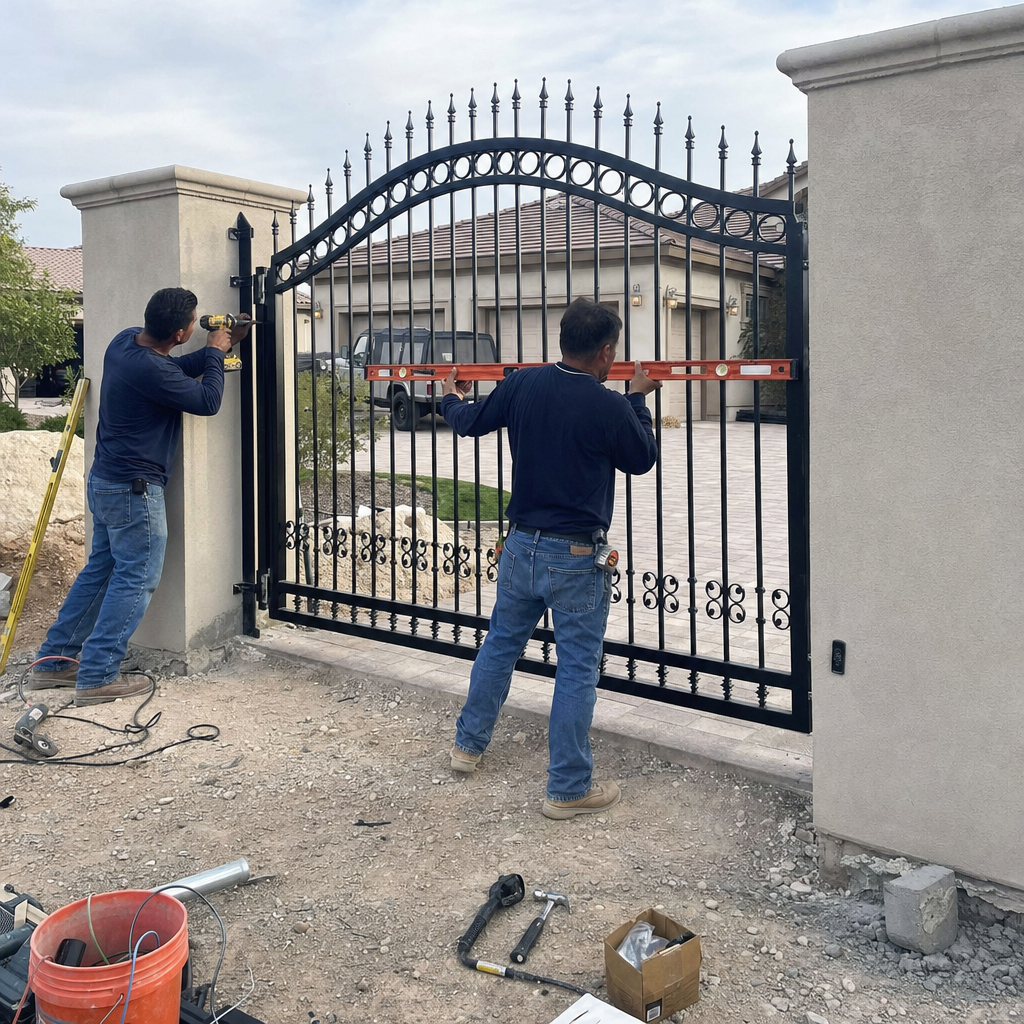
Most Las Vegas homeowners assume that swapping out a broken gate motor is no different from replacing a faucet — a repair job that flies under the radar. That assumption is usually correct, but the exceptions carry real consequences. A motor upgrade that increases amperage draw on a shared electrical panel at a Henderson condo complex, a new concrete post set to replace a rusted one, or an access control system wired into a building’s main feed — each of those crosses from “repair” into “modification” under Nevada building codes. In this guide, we draw the exact line between work that needs a permit and work that doesn’t, so you know exactly where you stand before any tools hit your gate.
Quick Answer
In Clark County and the City of Las Vegas, most routine gate repairs — spring replacements, hinge work, operator board swaps like-for-like — do not require a permit. A permit is typically required when the work involves new electrical wiring, a new concrete foundation or post, a change in gate size or structural configuration, or any modification to a shared-panel electrical connection. If you’re unsure which category your project falls into, calling your local building department before work begins takes about ten minutes and can save you thousands in forced demolition, re-inspection fees, or denied insurance claims.
Table of Contents
- Clark County vs. City of Las Vegas vs. Henderson: Which Authority Governs Your Gate?
- Permit Triggers: When a Gate Repair Legally Becomes a Modification
- HOA Overlay Rules: When Your CC&Rs Are Stricter Than the County
- Electrical Code Requirements for Automated Gate Systems in Nevada
- What Happens During a Gate Installation Inspection — and the Two Most Common Failures
- How to Verify Your Contractor Is Pulling Permits (and Not Skipping Them on Your Dime)
- Common Mistakes to Avoid
- When to Call a Professional
- Frequently Asked Questions
- The Bottom Line
Clark County vs. City of Las Vegas vs. Henderson: Which Authority Governs Your Gate?
Nevada’s patchwork of municipal jurisdictions trips up homeowners and contractors alike. Your physical address in the Las Vegas valley doesn’t automatically tell you which building department owns your permit process — and filing with the wrong authority delays everything.
Here’s how the map breaks down:
- Clark County Building Department — governs unincorporated areas of Clark County. This covers large swaths of the valley that carry a “Las Vegas” mailing address but are not inside any city limits. Summerlin (west of the 215), much of North Las Vegas’s surrounding parcels, and areas around Boulder Highway fall here. Clark County uses the International Building Code (IBC) and International Residential Code (IRC) as adopted with Nevada amendments.
- City of Las Vegas Development Services — governs addresses within the incorporated City of Las Vegas boundary. Downtown Las Vegas, the Arts District, many Centennial Hills properties, and portions of the west side fall under city jurisdiction. The City of Las Vegas adopted the 2018 IBC and 2017 NEC (National Electrical Code) with local amendments.
- City of Henderson Building & Safety — Henderson operates its own building department entirely. Green Valley, MacDonald Ranch, Anthem, and the newer Cadence master-planned community all answer to Henderson. Henderson has historically been the most enforcement-active municipality in Clark County for unpermitted gate installations at HOA communities.
- City of North Las Vegas — covers its own incorporated area north of Las Vegas. Separate permitting office, separate fee schedule.
- Boulder City — small but distinct. Boulder City has its own municipal code and a notably stricter design-review process for gates visible from public streets.
How to find your jurisdiction in under two minutes: Visit the Clark County Assessor’s website (assessor.clarkcountynv.gov), enter your parcel number or address, and look at the “Municipality” field. That field tells you exactly which building department to call.
Permit Triggers: When a Gate Repair Legally Becomes a Modification
The word “repair” has a specific meaning under building code — it means restoring something to its original condition using like-for-like materials and components. The moment work deviates from that definition, you’re in modification territory, and modification typically triggers a permit requirement.
Work that generally does NOT require a permit in Las Vegas-area jurisdictions:
- Replacing a failed gate operator with an identical or directly equivalent model (same voltage, same amperage draw, same mounting configuration)
- Swapping a control board, sensors, safety loops, or remote receiver within an existing operator
- Lubricating, adjusting, or realigning hinges and rollers on an existing gate panel
- Repainting or refinishing the gate surface without changing structural dimensions
- Replacing a broken weld on an existing gate panel in kind
- Replacing a gate panel with one of the same dimensions and material
Work that typically DOES trigger a permit requirement:
- Installing a new electrical circuit or sub-panel circuit to feed a gate operator — this is a new electrical installation under the NEC, full stop
- Adding gate automation to a gate that was previously manual (new electrical, new foundation work for operator mounting)
- Setting a new concrete foundation for gate posts or operator pedestals
- Widening or narrowing the gate opening (changes structural load on the posts)
- Replacing existing wood posts with steel posts in a new concrete footing
- Installing an intercom or access control system that connects to a building’s low-voltage or line-voltage wiring
- Adding a second gate to a previously single-gate opening
In our experience working gates across Las Vegas neighborhoods from Summerlin to Green Valley, the most common gray-zone scenario is a homeowner who wants to upgrade from a Mighty Mule single-gate opener to a heavy-duty FAAC or BFT dual-gate system. That upgrade almost always involves new electrical and new mounting hardware — which means a permit conversation needs to happen before the first wire is run.
HOA Overlay Rules: When Your CC&Rs Are Stricter Than the County
Here’s something Clark County’s building department won’t tell you: getting a county permit doesn’t mean your HOA will approve the work. Homeowners associations in Las Vegas-area master-planned communities operate under Covenants, Conditions & Restrictions (CC&Rs) that can be substantially more restrictive than the building code — and the county has no enforcement role over those private agreements.
Common HOA gate restrictions we see regularly in the Las Vegas market:
- Aesthetic approval for gate materials and finish: Many HOAs in communities like Summerlin and Henderson’s Anthem require Architectural Review Committee (ARC) approval before you change gate material, color, or style — even if the dimensions stay identical.
- Operator visibility restrictions: Some HOAs prohibit surface-mounted operators visible from the street. This rules out certain LiftMaster and Linear above-ground swing gate operators and pushes homeowners toward below-ground FAAC or BFT underground operators.
- Keypad and intercom placement rules: DoorKing and similar access control pedestals must often be set within specific height and setback ranges from the property line per CC&Rs.
- Shared gate maintenance responsibility: At condo complexes and gated communities with shared entry gates, CC&Rs frequently define which components are an individual owner’s responsibility versus the HOA’s. Upgrading a shared operator without HOA authorization can expose you to chargeback liability — we’ve seen this play out in North Las Vegas communities.
- Color and finish matching: Powder-coat color must often match a community standard. This affects welding repairs as much as new installations — a fresh weld patch in a mismatched color can trigger an ARC violation notice.
The practical takeaway: Before any gate project at an HOA property, request a copy of the architectural guidelines from your HOA management company. Review them alongside — not instead of — whatever the building department requires. Both approvals may be needed, and they run on parallel, unrelated timelines.
Electrical Code Requirements for Automated Gate Systems in Nevada
Nevada has adopted the National Electrical Code (NEC) with state and local amendments. For automated gate systems in the Las Vegas valley, the most relevant NEC articles are Article 300 (wiring methods), Article 400 (flexible cords), and Article 680 (which applies if the gate is near a pool or water feature — more common than you’d think in Las Vegas backyards).
Key electrical requirements that apply to gate automation work in Nevada:
- Dedicated circuit requirement: Most commercial-grade gate operators — including FAAC, BFT, and Viking — draw enough current that a dedicated circuit is required or strongly recommended. Sharing a circuit with other loads is a code violation risk and a motor longevity issue.
- GFCI protection: Any outlet installed within 6 feet of a water source, or in an outdoor location, requires GFCI protection under the NEC. Gate operator outlet boxes mounted on exterior walls or pedestals nearly always fall into this category in Las Vegas.
- Conduit burial depth: Underground wiring to a gate operator pedestal must meet NEC burial depth minimums — typically 12 inches for GFCI-protected circuits in conduit, 24 inches for direct-burial wire without conduit. Clark County inspectors flag shallow trenches regularly.
- Entrapment protection: UL 325 — the safety standard for gate operators, not an NEC article, but inspectors reference it — requires entrapment protection devices (edge sensors, photo eyes, or loop detectors) on all automated vehicular gates. A gate operator without functioning entrapment protection will fail inspection.
- Accessible disconnect: The electrical feed to a gate operator must include an accessible disconnect switch within sight of the operator. This is a frequent inspection flag on older installs that got upgraded without running a proper disconnect.
Ghost Controls, LiftMaster, and Elite (the brand) operators designed for residential use typically run on 120V circuits and have lower amperage draws that simplify the electrical side. Commercial operators from FAAC and BFT may require 240V service — a different permit category with a longer inspection cycle in Clark County.
What Happens During a Gate Installation Inspection — and the Two Most Common Failures
When a permit is issued for gate work involving electrical or structural components in Clark County or the City of Las Vegas, a building inspector will schedule a rough-in inspection (before conduit is buried or walls are closed) and a final inspection (once work is complete). Here’s what that process looks like in practice:
- Permit issuance and job-card posting: The permit must be posted on-site and visible. The inspector will check for this first.
- Rough-in inspection (if applicable): For any new electrical work, the inspector checks conduit routing, burial depth, box fill, conductor sizing, and grounding before the trench is backfilled or conduit is concealed.
- Final inspection: The inspector verifies the completed installation against the approved plans — operator mounting, entrapment protection devices, disconnect switch presence and placement, GFCI protection, and that the gate reverses properly on contact with an obstruction.
- Certificate of occupancy or final sign-off: Once the inspector signs off, the permit closes. Keep a copy of the final sign-off in your property files — it matters at resale and for insurance claims.
The two most common gate installation failures we see flagged by Las Vegas-area inspectors:
1. Missing or non-functional entrapment protection. UL 325 requires that a vehicular gate operator stop and reverse when it contacts an obstruction. Inspectors test this. Photo eyes misaligned by even a fraction of an inch due to post movement — which happens regularly in Las Vegas’s expansive clay soils — will fail the test. Edge sensors on swing gate leading edges are also commonly missing entirely on DIY installs.
2. Insufficient conduit burial depth. The Las Vegas valley’s hardpan caliche layer makes trenching difficult, and we’ve seen more than a few installations where the conduit was buried at 6–8 inches rather than the code-required 12–24 inches. Inspectors measure. A failed burial-depth inspection means re-trenching, which is expensive and disruptive after landscaping has been restored.
How to Verify Your Contractor Is Pulling Permits Properly
A contractor who skips permits to save time is shifting legal and financial risk onto you as the property owner. Unpermitted work can result in stop-work orders, forced removal, reinspection fees, and — critically — denied homeowner’s insurance claims if an incident occurs involving the unpermitted installation. Here’s how to verify before it becomes your problem:
- Ask for the permit number before work begins. Any contractor performing permit-required work should pull the permit before starting, not after. If they say “we’ll handle it later,” that’s a red flag.
- Verify the permit on the building department’s public portal. Clark County, the City of Las Vegas, and Henderson all offer online permit lookup by address. Enter your address and confirm an open permit exists with your contractor’s license number attached to it.
- Confirm the contractor’s Nevada State Contractors Board (NSCB) license. In Nevada, any gate work that includes electrical, structural, or low-voltage wiring requires a contractor holding the appropriate NSCB license classification. You can verify license status at nscb.nv.gov in under two minutes.
- Request the final inspection sign-off in writing. Don’t accept verbal confirmation. When the job is done, ask for a copy of the signed final inspection card or the digital close-out record from the building department portal.
- Check your HOA approval status separately. Confirm in writing from your HOA management company that any required ARC approval was granted. A county permit and an HOA approval are two independent documents — having one doesn’t give you the other.
At Elite Gate Repair Expert Vegas, Albert Foster handles the permit coordination discussion upfront on every job where it applies — because the paperwork is part of the job, not an afterthought.
Common Mistakes to Avoid
- Assuming your Las Vegas mailing address means City of Las Vegas jurisdiction. Thousands of homes with a “Las Vegas, NV” mailing address sit in unincorporated Clark County. Filing a permit with the wrong department delays your project and may mean starting the application process over entirely.
- Treating a motor upgrade as a straight swap when it isn’t. Moving from a Ghost Controls or Mighty Mule residential opener to a commercial-grade FAAC or BFT unit often means new electrical requirements. Homeowners in Summerlin and Henderson who’ve done this without a permit have faced reinspection demands during home sales when the upgrade showed up in a buyer’s inspection report.
- Starting HOA gate work without ARC approval. Clark County issuing a permit does not override your HOA’s CC&Rs. ARC violations in communities like Anthem and MacDonald Ranch can result in mandatory removal of completed work — a costly lesson.
- Skipping entrapment protection on a DIY gate automation project. Photo eyes, edge sensors, and obstruction-reversing logic are not optional add-ons — they’re UL 325 requirements that an inspector will test. A gate that doesn’t reverse on contact is also a liability exposure that no homeowner wants.
- Burying conduit too shallow in caliche soil. Las Vegas’s hardpan makes digging to code depth genuinely hard work, and it’s tempting to stop early. Don’t. Clark County inspectors measure, and a failed rough-in inspection means re-trenching through landscape you’ve already restored.
- Not keeping permit documentation after project completion. Final inspection sign-offs are material documents for title insurance, HOA resale disclosure, and homeowner’s insurance claims. Store them with your property records the same day they’re issued.
- Hiring a generalist handyman for work that requires a licensed contractor classification. In Nevada, electrical and low-voltage gate wiring work requires an NSCB-licensed contractor. A handyman without the proper classification cannot legally pull the permit — which means the permit may never get pulled at all.
When to Call a Professional
Some gate problems are genuinely DIY-friendly — lubricating a squeaky hinge, reprogramming a remote, replacing a dead battery in a Viking or Linear receiver. But these scenarios call for a specialist, not a generalist:
- Any gate work that involves new wiring, a new circuit, or a connection to an existing electrical panel
- Gate automation upgrades from manual to automatic — especially at HOA shared-entry gates in Las Vegas communities
- Structural post replacement, new concrete footings, or any work that changes the gate opening geometry
- Commercial gate operators from brands like FAAC, BFT, or DoorKing that run on 240V service
- Access control systems that integrate with a building’s low-voltage infrastructure
- Any job where you need permit documentation for a home sale, insurance claim, or HOA compliance
Elite Gate Repair Expert Vegas — led by Albert Foster, who personally handles technical work on every job — offers free estimates for gate projects across Las Vegas. Albert works on all nine major gate brands including LiftMaster, FAAC, BFT, Linear, Viking, Ghost Controls, DoorKing, Elite, and Mighty Mule, and can walk you through the permit question before any work begins. Call (725) 210-0591 to schedule a no-cost evaluation.
Frequently Asked Questions
Do I need a permit to replace a broken gate motor in Las Vegas?
In most cases, no — replacing a gate motor with a like-for-like unit that uses the same electrical connection does not require a permit in Clark County or the City of Las Vegas. A permit is required if the replacement motor draws more amperage than the existing circuit supports, requires a new dedicated circuit, or involves new conduit burial. If you’re upgrading from a light-duty residential opener to a heavy-duty commercial operator, assume a permit conversation is needed and call your local building department before work begins. Not sure which situation you’re in? Call (725) 210-0591 for a free assessment.
Which building department handles my Las Vegas-area address?
Your jurisdiction depends on whether your address falls within an incorporated city or in unincorporated Clark County. Enter your parcel number at the Clark County Assessor’s site (assessor.clarkcountynv.gov) and check the “Municipality” field. If it reads “Clark County,” your permits go through Clark County Building Department. Henderson, North Las Vegas, and City of Las Vegas addresses each have their own departments. Getting this right upfront saves weeks of delay.
Can my HOA block gate work even if the county approved a permit?
Yes — absolutely. A county building permit and HOA architectural approval are completely independent. Your HOA’s CC&Rs may restrict gate materials, operator visibility, keypad placement, or color finishes in ways the county doesn’t regulate at all. In communities like Anthem in Henderson and Summerlin in the Las Vegas valley, ARC violations have resulted in homeowners being required to remove completed, permit-approved work. Always secure both approvals in writing before starting.
What is UL 325 and does it apply to my residential gate in Nevada?
UL 325 is the safety standard for vehicular gate operators. It requires entrapment protection — photo eyes, edge sensors, or obstruction-reversing logic — on all automated vehicular gates. It applies to residential and commercial installations throughout Nevada. Clark County and City of Las Vegas inspectors test entrapment protection during final inspection on any permitted gate project. Even on non-permitted repairs, a gate operator that doesn’t reverse on contact with an obstruction is a liability exposure and a safety hazard.
How deep does conduit have to be buried for a gate operator in Nevada?
Under the NEC as adopted in Nevada, conduit carrying circuits protected by GFCI must be buried at least 12 inches deep. Direct-burial cable without conduit requires 24 inches. In Las Vegas’s caliche-heavy soil, hitting those depths is physically demanding, and shallow burial is one of the two most common inspection failures on gate installations. Dig to depth before backfilling — re-trenching after the fact is expensive and disruptive.
Does Albert Foster pull permits for gate jobs in Las Vegas?
For any gate project that triggers a permit requirement under Clark County, City of Las Vegas, or Henderson code, Albert addresses the permit process as part of the job scope — not as an afterthought. The permit question is part of the initial estimate conversation. You can reach Albert directly at (725) 210-0591 to discuss whether your specific project requires a permit before any work is scheduled.
The Bottom Line
Most gate repairs in the Las Vegas valley are permit-exempt — but the exceptions matter more than most homeowners realize. Electrical work, new foundations, gate automation upgrades, and structural modifications all cross the line from repair into modification and typically require a permit. Your jurisdiction (Clark County, City of Las Vegas, Henderson, or another incorporated city) determines which building department to call, and your HOA’s CC&Rs may add restrictions that run parallel to — and independently of — whatever the county requires. Verify permits through public portals, keep final inspection documentation with your property records, and don’t let a contractor skip the process to save a few days. The liability risk isn’t worth it.
For gate projects across Las Vegas — from a quick Gate Repair in Winchester to a full Gate Installation in Winchester or a Gate Motor & Opener in Winchester upgrade — Albert Foster at Elite Gate Repair Expert Vegas handles the technical work personally, works on all nine major gate brands, and brings three years of Las Vegas-focused gate expertise and 189 verified five-star reviews to every job. Call (725) 210-0591 for a free estimate.
Written by Albert Foster, Owner & Lead Technician at Elite Gate Repair Expert Vegas, serving Las Vegas since 2023.